
REVIEW · WALKING TOURS
Discover Valletta Half-Day Walking Tour
Valletta’s compact grid makes it a fine city for a guided walk, and this tour covers the main sights from the Triton Fountain to Fort St. Elmo in about three hours and 15 minutes. You’ll see Renzo Piano’s modern City Gate, Baroque palaces, fortress walls, and one of Malta’s best harbour views.
I like the low price of $22.11 and the useful 45-minute break at St. John’s Co-Cathedral, where you can buy admission, shop, or sit at a café. I also like that a guide handles the route while you keep the rest of your afternoon free. The main caution is the group size, which can reach 50 people, and one past booking had nearly an hour of waiting before everyone was ready.
In This Review
- Key points at a glance
- Why this half-day route works in Valletta
- Meeting at the Triton Fountain at 9:15 am
- City Gate and Valletta’s modern face
- Opera House ruins and the Baroque heart of Valletta
- Upper Barrakka Gardens and the Grand Harbour view
- Auberge d’Italie and Palazzo Parisio
- The 45-minute choice at St. John’s Co-Cathedral
- St. George’s Square and the Grandmaster’s Palace
- Fort St. Elmo and the walk to The Malta Experience
- What the $22.11 price really buys you
- Who should book this Valletta walking tour?
- Should you book it?
- FAQ
- How long is the Discover Valletta Half-Day Walking Tour?
- Where does the tour begin?
- Where does the tour end?
- Is hotel pickup included?
- Is admission to St. John’s Co-Cathedral included?
- What languages are available?
- How large can the group be?
- Can I visit The Malta Experience after the walking tour?
Key points at a glance
- Start at the Triton Fountain: Meet outside Valletta near The Phoenicia Malta at 9:15 am.
- See old and new Valletta together: The route pairs the 16th-century city with Renzo Piano’s 2014 City Gate and New Parliament.
- Enjoy the Grand Harbour from Upper Barrakka Gardens: The 15-minute pause is one of the tour’s best photo stops.
- Choose how to use your free time: Spend 45 minutes at St. John’s Co-Cathedral, shop on Republic Street, or stop for a drink.
- Finish near Fort St. Elmo: The tour ends at The Malta Experience at 12:45 pm, with an optional 1 pm show available at extra cost.
- Expect a budget group outing: The maximum is 50 people, so this suits value-minded visitors more than those seeking a quiet, intimate walk.
Why this half-day route works in Valletta
Valletta is small on a map, but its layers can be hard to sort out on your own. Knights of the Order of St. John, British rule, World War II, modern Malta, and the country’s political life all meet within a short walk.
This route gives you a useful first look. It does not take you through every museum or provide long visits inside each monument. Instead, it links the city’s most important public spaces and buildings, then gives you a chance to choose one major attraction for a longer look.
That structure keeps the cost down. At $22.11 per person, the tour is priced more like an orientation walk than a full sightseeing package. You are paying for the guide, the route, and the explanations, while entrance tickets remain your choice.
This matters in Valletta because admission costs can add up quickly. You may want to visit St. John’s Co-Cathedral, the Grandmaster’s Palace, the National War Museum, or The Malta Experience, but you may not want to pay for all of them. Here, you can decide as you go.
A few more Malta trips to weigh up
- The Original Valletta Walking Tour
★ 5.0 · 2,719 reviews - Valletta: 3-Hour Walking Tour
★ 4.7 · 1,605 reviews - Valletta: Guided City Walking Tour
★ 4.8 · 1,256 reviews
Meeting at the Triton Fountain at 9:15 am
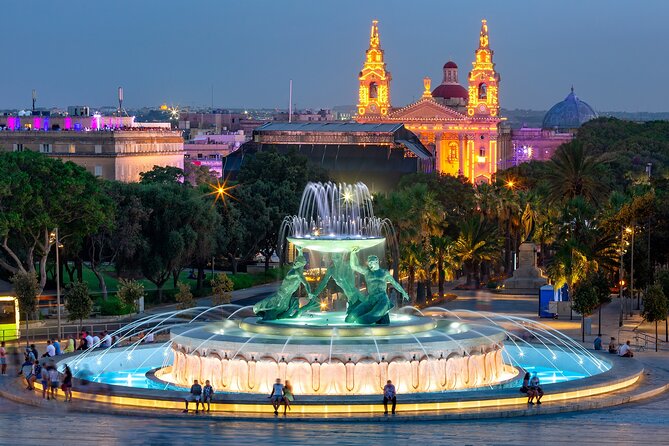
The meeting point is The Phoenicia Malta, at The Mall in Floriana, just outside Valletta’s main entrance. The nearby Triton Fountain is an easy landmark to recognize. It shows three bronze Tritons supporting a large basin and was first inaugurated in 1959 before being restored in 2018.
Allow time to find the meeting point and arrive early. The tour starts at 9:15 am, and the group may include people arriving by public transport or from nearby hotels. The information says most people can participate, and service animals are allowed.
The tour does not include hotel pickup or drop-off. That is normal for a city walking tour, but it means you need to arrange your own way to Floriana. The meeting location is near public transportation, which helps if you are staying outside the historic center.
One practical issue is group readiness. A past experience included a long delay while the full group assembled. I would arrive early, confirm the guide and language, and keep your morning schedule flexible. If you have a timed museum ticket soon after 12:45 pm, leave a generous buffer.
City Gate and Valletta’s modern face
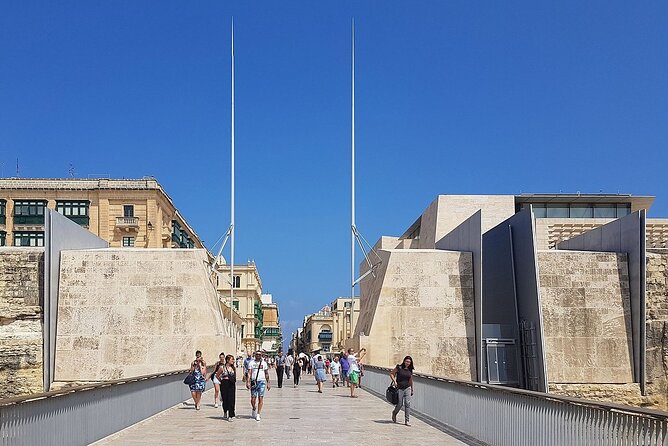
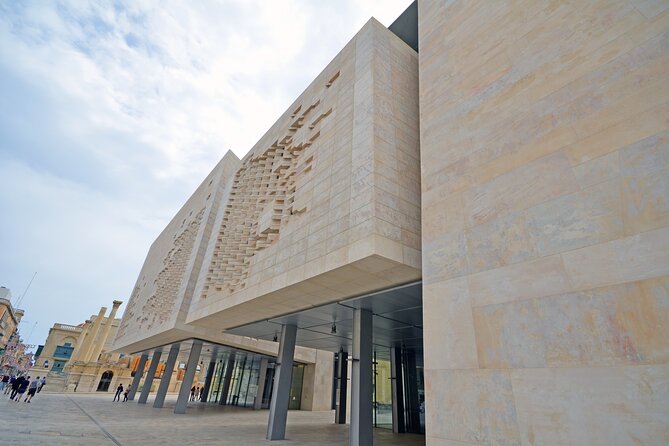
The first formal stop is Valletta City Gate, the fifth gate built on this site. It sits within the Porta Reale Curtain, between St. James’ and St. John’s Bastions, and marks the beginning of Republic Street.
The present gate was completed in 2014 from designs by Italian architect Renzo Piano. Its clean, spare form is a sharp contrast to the honey-colored stone and ornate Baroque buildings farther inside the city.
That contrast is part of the appeal. Valletta is not a frozen old town. It is a working capital with new government buildings placed beside fortifications that date back centuries.
The nearby New Parliament is also part of Piano’s City Gate project. Its two blocks are connected by bridges, and the steel frame is clad in Gozitan limestone. The design is meant to suggest honeycombs, a reference to Melite, the ancient name associated with Malta and honey.
You will have only about five minutes at each of these early stops. That is enough for a guide to explain the basic story and point out the design, but not enough for a detailed architectural study. If modern design is a major interest, note the buildings and return later at your own pace.
Opera House ruins and the Baroque heart of Valletta
The Royal Opera House site gives you a quick lesson in Malta’s wartime experience and its modern cultural life. The original theater, designed by English architect Edward Middleton Barry, opened in 1866. Aerial bombing destroyed it in 1942 during World War II.
The ruins were later redesigned by Renzo Piano, and the site returned to use as a performance venue in 2013. It is a good example of how Valletta handles damaged historic structures without pretending the past never changed.
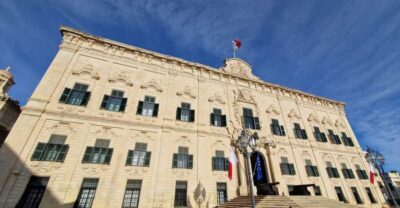
The walk then continues to Auberge de Castille, one of the city’s most impressive Baroque buildings. Built in the 1740s under Grand Master Manuel Pinto da Fonseca, it replaced an earlier building for knights from the langue of Castile, León, and Portugal.
Auberge de Castille sits at Valletta’s highest point and now houses the Office of the Prime Minister of Malta. You will view it from outside, so take time to look at the formal façade and its position above the surrounding streets. The five-minute stop is brief, but the guide’s explanation helps you understand why the building matters.
Same islands, a completely different day out:
- Malta: Gozo & Comino Islands, Blue Lagoon & Seacaves Tour
★ 4.5 · 15,672 reviews - Comino: Blue Lagoon, Crystal Lagoon, and Seacaves Tour
★ 4.6 · 5,673 reviews - Malta: Blue Lagoon, Beaches & Bays Trip by Catamaran
★ 4.7 · 5,496 reviews - Malta: Gozo, Comino, Blue & Crystal Lagoon, & Caves Cruise
★ 4.6 · 5,092 reviews
Upper Barrakka Gardens and the Grand Harbour view
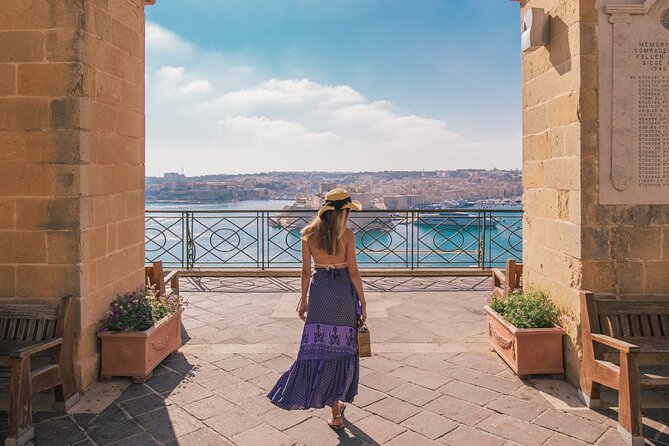
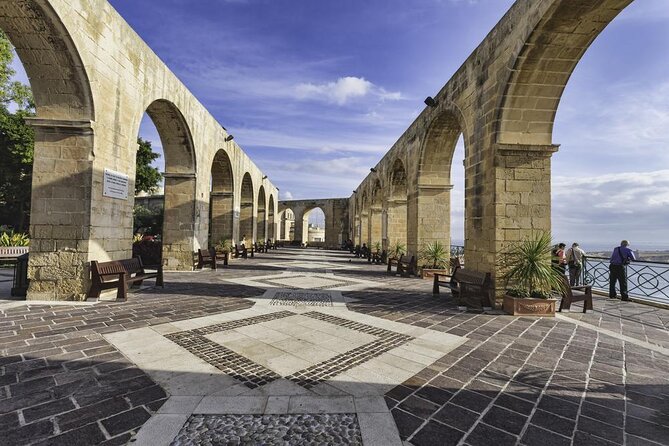
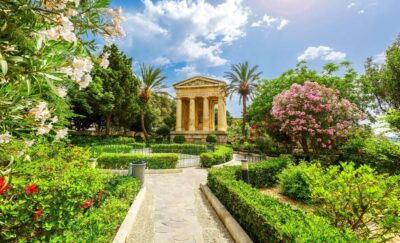
Upper Barrakka Gardens is the tour’s main pause for scenery. The gardens occupy the upper level of St. Peter and Paul Bastion, built in the 1560s, and were originally used by knights of the Italian langue of the Order of St. John.
The terrace sits at the highest point of Valletta’s walls. From here, you can look across the Grand Harbour toward the Three Cities, the shipyard, and the lower parts of the capital.
You get about 15 minutes here, which is enough to take photographs, catch your breath, and get your bearings. I consider this one of the most valuable stops because it shows the reason Valletta was built where it is. The city’s defensive position becomes clear when you see the harbours spread below the bastions.
The short break also helps break up the steady pace of the walk. Still, do not expect a long garden visit or a leisurely coffee stop. If you want more time at Upper Barrakka Gardens, you will need to return after the tour.
Auberge d’Italie and Palazzo Parisio
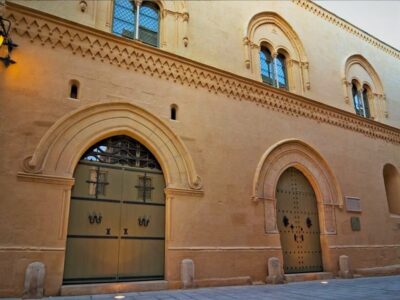
The route next passes Auberge d’Italie, built in the late 16th century for knights from the Italian langue of the Order of St. John. Since 2018, the building has housed MUŻA, Malta’s National Art Museum.
The tour only allows a short exterior look, and admission is not included. That makes this another place to mark for a later visit if you want art rather than architecture. The building’s original purpose also helps explain the Order’s organization, since the knights were grouped by language or national association.
Palazzo Parisio brings another layer of political and social history. Built in the 1740s, it passed through the Muscati and Parisio Muscati families. Napoleon stayed there for six days in June 1798, during the early French occupation of Malta.
The building later became a government property and served as the General Post Office from 1886 to 1973. It then housed the Ministry for Agriculture and now contains the Ministry for Foreign Affairs.
Again, expect a five-minute introduction rather than an indoor visit. That pattern is useful if you want a broad overview, but limiting if you prefer to study a few places in depth.
The 45-minute choice at St. John’s Co-Cathedral
St. John’s Co-Cathedral is the most important decision point on the tour. You get 45 minutes of free time, and admission is not included.
If you buy a ticket, you can visit the cathedral and museum, including the Oratory, Caravaggio paintings, Flemish tapestries, and church museum. The building is also known for its elaborate marble inlaid floor. Admission includes a multilingual audio guide.
Forty-five minutes gives you a reasonable first look, but it is not a relaxed, detailed visit to every part of the complex. If the cathedral is your top priority, check the entrance process and move directly there during the free period.
You can also skip the interior. Republic Street is Valletta’s main shopping street, and cafés around Republic Square and nearby piazzas provide a place to rest. This flexibility is one of the tour’s strongest features. A mixed group does not have to share the same interests for the entire morning.
Make sure you remember the agreed meeting place and time. The group reforms after the 45-minute break for the final section of the walk.
St. George’s Square and the Grandmaster’s Palace
St. George’s Square is Valletta’s largest and most prominent square. It sits in front of the Grandmaster’s Palace, a building constructed between the 16th and 18th centuries for the leader of the Order of St. John.
The square has changed since the 17th century, but it remains a central setting for public events. It is a useful place to pause and understand Valletta as a capital, not only as a fortified historic center.
The Grandmaster’s Palace is now connected with Malta’s presidency. It also contains the Palace State Rooms and Palace Armoury, both open to the public as museums. Parliament met here from 1921 until 2015.
You will only see the building briefly from the outside unless you return on your own. Admission is not included, so the tour works best as an introduction. If you want palace rooms, armor, or a longer look at Malta’s government buildings, plan a separate visit.
Fort St. Elmo and the walk to The Malta Experience
The final major sight is Fort St. Elmo, a star fort on the seaward side of the Sciberras Peninsula. It commands the entrances to Marsamxett Harbour and Grand Harbour and played a major part in the Great Siege of Malta in 1565.
Part of the fort has housed the National War Museum since 1975. The stop is short, about five minutes, so you should not expect a full museum visit. Still, its location gives the morning a strong ending. You have moved from the city gate, through political and religious landmarks, to the fortifications that explain Valletta’s military purpose.
The walking tour ends at The Malta Experience at 12:45 pm. You can buy a ticket for the 1 pm, 45-minute multilingual audio-visual show about Malta’s story through the centuries. You can also stop for a drink or snack with a view over the Grand Harbour before making your own way back.
The show is optional and costs extra. It is a convenient add-on because the tour ends at the entrance, but you should account for the additional ticket price and time before making afternoon plans.
What the $22.11 price really buys you
At $22.11, this is a sensible buy if you want orientation, structure, and a licensed guide without committing to a full-day program. The route covers a lot of ground, and the free time lets you decide which attraction deserves your money.
You should not view the price as covering Valletta’s main museums. Nearly every indoor attraction listed has admission fees that are not included. The value comes from learning where things are, hearing the basic story, and saving time on route planning.
The group format keeps the cost low but affects the pace. With a maximum of 50 people, the guide may need to gather the group repeatedly at busy streets and squares. Explanations may also be shorter than on a private tour.
Guide quality can shape the experience. Josephine received especially warm praise for making the morning enjoyable, and Maria was singled out for her friendliness and ability to lead an interesting city visit. One Spanish-speaking booking found the information too basic and was disappointed when the tour operated bilingually. Tours normally run in one language, but occasionally two languages may be used, so this is worth checking when you book.
Who should book this Valletta walking tour?
I would recommend it to first-time visitors who want a clear introduction to Valletta before exploring independently. It also suits cruise passengers, short-stay visitors, and anyone who wants the afternoon free for a museum, beach, meal, or another Malta outing.
The route is a good fit if you enjoy seeing major landmarks from the outside and choosing only one or two interiors. It is less suitable if you want long guided visits inside St. John’s Co-Cathedral, the Grandmaster’s Palace, or Fort St. Elmo.
You should also think about the group size. If you value a quiet pace and detailed conversation, a private tour may suit you better. If your main goal is to keep costs down while getting a useful first look at the capital, this group walk makes practical sense.
Free cancellation is available up to 24 hours before the 9:15 am start for a full refund. Changes or cancellations inside that window are not accepted for a refund.
Should you book it?
Book this tour if you want an affordable morning overview of Valletta, especially for the Upper Barrakka Gardens view, the city’s landmark architecture, and the chance to choose your own use of the 45-minute cathedral break.
Skip it if you want a slow, highly detailed study of Maltese history or guaranteed one-language commentary in a small group. For most budget-minded visitors, the route offers a useful first framework. Just arrive early, confirm the meeting details and tour language, and treat the paid attractions as optional extras rather than part of the base price.
FAQ
How long is the Discover Valletta Half-Day Walking Tour?
The tour lasts approximately 3 hours and 15 minutes. It begins at 9:15 am and ends at The Malta Experience at 12:45 pm.
Where does the tour begin?
The meeting point is The Phoenicia Malta, The Mall, Floriana, Malta. The Triton Fountain is located just outside Valletta’s City Gate nearby.
Where does the tour end?
The walk ends at The Malta Experience, St. Elmo Bastions, Triq Il-Mediterran, Valletta, at 12:45 pm.
Is hotel pickup included?
No. Hotel pickup and drop-off transportation are not included.
Is admission to St. John’s Co-Cathedral included?
No. You have 45 minutes of free time to buy admission if you wish. The ticket covers the cathedral and museum, including the Caravaggio masterpieces in the Oratory, Flemish tapestries, and a multilingual audio guide.
What languages are available?
The professional licensed guide may speak English, French, German, Italian, or Spanish, according to the language booked. Tours normally operate in one language, though they may occasionally operate bilingually.
How large can the group be?
The tour can have a maximum of 50 participants.
Can I visit The Malta Experience after the walking tour?
Yes. The walking tour ends at its entrance, and you can buy a ticket for the 1 pm, 45-minute multilingual audio-visual show. The ticket and any drinks or snacks are not included.
Just added around Malta
- Malta: 5 hr Vintage Bus Tour – Mdina & Blue Grotto inc. food★ 5.0 · 22 reviews
- Wakeboarding Adventure in Malta: Learn to Ride★ 5.0 · 4 reviews
- World War II Malta Full-Day Walking Tour★ 4.3 · 18 reviews
- Valletta Street Food & History Tour With Private Transfers★ 4.5 · 15 reviews
- Victoria, Gozo: Sunset Walking Food and Drink Tour★ 5.0 · 6 reviews
- Valletta & Mdina: Private Tour★ 4.5 · 16 reviews
- Valletta: Private Maltese Cuisine Walking Tour★ 4.8 · 8 reviews
- Valletta: Private Massage from a world renowned masseuse★ 4.6 · 9 reviews
Walking Tours, compared.

Guided Walking Tour with Optional Cathedral Tour
Read our review →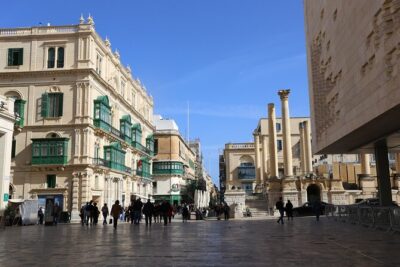
The Valletta Street Food and Culture Walking Tour
Read our review →Browse the lists this tour appears in