
REVIEW · HISTORICAL TOURS
Heritage Pass in Malta
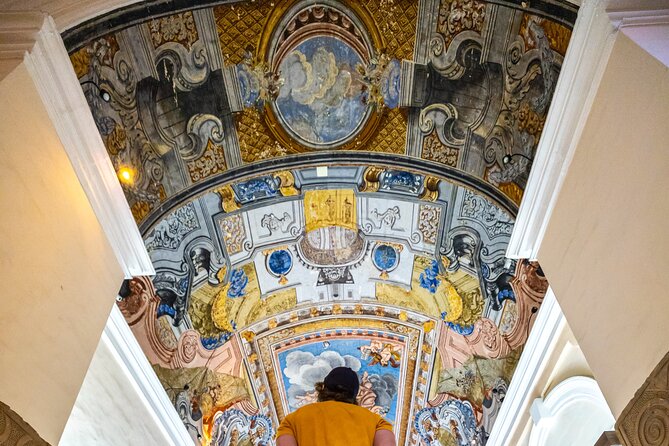
Malta’s story is packed into a small group of islands, and this pass gives you a practical way to connect its major forts, prehistoric temples, Roman remains, and underground tombs. You can move from Fort St. Elmo to the ancient temples at Ħaġar Qim, then cross the harbor for Birgu’s Fort St. Angelo and Maritime Museum.
I like the pass for two clear reasons: it links more than 20 Heritage Malta sites with unlimited hop-on hop-off bus travel, and it adds both a harbor cruise and a coastal route toward Comino and Gozo. That is a lot of transport and sightseeing in one purchase.
The catch is value. At $92.69 per person, you need to visit several paid sites and use the transport well. Some pass details also appear inconsistent, especially the stated three-day period versus information indicating six days, so confirm the exact terms and scan the QR code for current opening hours before you begin.
In This Review
- Key points to know before buying
- What the Heritage Pass actually gives you
- Valletta’s forts, art, and armor
- The Three Cities and Malta’s maritime story
- Mdina and the world beneath the streets
- Malta’s oldest temples at Ta’ Ħaġrat and Skorba
- The southern temple coast: Ħaġar Qim and Mnajdra
- Għar Dalam and the southern prehistoric sites
- How to plan three days without racing
- Is $92.69 a fair price?
- Who should buy it?
- FAQ
- How long is the Heritage Pass valid?
- How much does the Heritage Pass cost?
- Which attractions are included?
- Does the pass include public transportation?
- Is a cruise included?
- Is Wi-Fi available on the cruises?
- Can the State Rooms close?
- How can I check attraction opening times?
- Can I cancel for a refund?
Key points to know before buying
- More than 20 historical attractions: Visit forts, museums, prehistoric temples, Roman remains, and catacombs with one pass.
- Three-day format in the advertised offer: The pass is presented as a three-day product, though other information refers to a six-day validity period. Check your ticket carefully.
- Unlimited hop-on hop-off buses: The buses help connect Valletta, the Three Cities, Mdina, temple sites, and other parts of Malta.
- Two water-based outings: The package includes a Valletta and Three Cities harbor cruise plus a coastal pass route toward Comino and Gozo.
- Plan around opening hours: Some attractions can close at short notice, and the Presidential Palace State Rooms may be unavailable by presidential order.
- Best for active sightseers: You get the most from the pass if you want several museums and monuments rather than just one or two headline sites.
What the Heritage Pass actually gives you
The Heritage Pass is built around three parts: attraction entry, sightseeing buses, and boat trips. The attraction list covers much more than Valletta. You can visit Malta’s fortified harbor cities, the old capital of Mdina, the southern temple sites, and several small archaeological museums.
That range matters because Malta is not one compact sightseeing district. Valletta is easy to explore on foot, but Ħaġar Qim, Għar Dalam, Fort St. Angelo, and St. Paul’s Catacombs are spread across the island. The buses reduce the need to arrange separate transport, though you still need to allow time for routes and connections.
The harbor cruise gives you a different view of Valletta and the Three Cities. Both cruises include free Wi-Fi, a modest but useful touch if you want to check route information or stay in contact while on the water.
The pass is not a guided walking tour. You are mainly choosing your own stops and setting your own pace. That freedom is useful, but it also means you must do the planning. The strongest parts of the pass come when you group nearby sights instead of crossing the island for one short visit.
A few more Valletta trips to weigh up
- Valletta: Self-Guided Historical Walking Tour (Audio Guide)
★ 3.7 · 251 reviews - Hagar Qim temple (UNESCO) and Limestone Heritage guided tour
★ 3.5 · 11 reviews - Hagar Qim temple (UNESCO), Limestone Heritage & Marsaxlokk Market guided tour
★ 4.0 · 10 reviews
Valletta’s forts, art, and armor
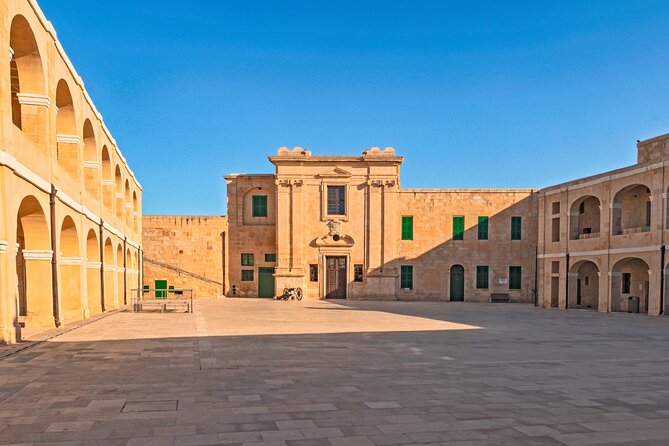
Begin in Valletta with the National War Museum at Fort St. Elmo. This star-shaped fort guards the entrances to Marsamxett Harbour and Grand Harbour, and its role in the Great Siege of 1565 gives the building real weight. Allow about an hour, but leave extra time for the views and the fort’s large defensive layout.
Fort St. Elmo is one of the best first stops because it gives you Malta’s military story in its proper setting. You are not simply looking at weapons in a gallery. You are inside the fort that helped control access to the harbor.
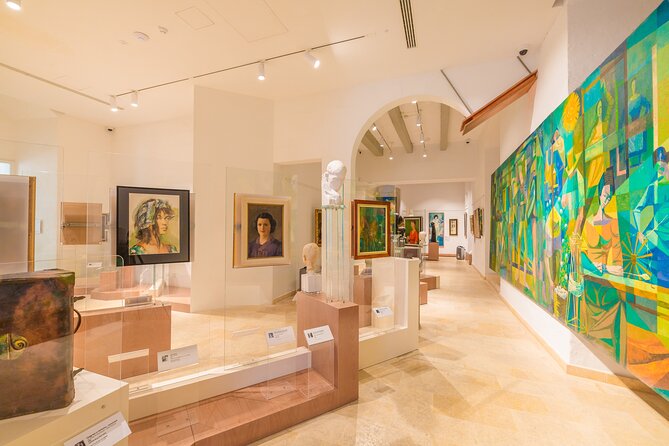
MUŻA, the Malta National Community Art Museum, offers a change of pace. Housed in the Auberge d’Italie, it presents Maltese and foreign works across major European styles. The museum helps you see Malta beyond its forts and churches, with art placed in a historic building at the center of Valletta.
The Palace Armoury is another useful Valletta stop. Its collection includes armor linked with Grand Masters Alof de Wignacourt and Jean de Valette, along with Ottoman armor, weapons, and artillery. I would pair it with Fort St. Elmo, since the fort shows military power on a grand scale while the Armoury brings that world close to eye level.
The State Rooms of the Presidential Palace are more unpredictable. These rooms occupy a palace begun soon after Valletta was founded in 1566. The building served the Knights of St. John, later became the Governor’s Palace under British rule, and hosted Malta’s first constitutional parliament in 1921.
The State Rooms can close at short notice by order of the President. Do not build your entire day around this one stop. If it is open, it adds ceremony and political history. If it is closed, use the pass at another site instead.
The Three Cities and Malta’s maritime story
Across the water from Valletta, Fort St. Angelo sits at the center of Grand Harbour in Birgu. It began as a medieval castle and was rebuilt by the Order of St. John into a bastioned fort during the 16th century. The fort served as the Order’s headquarters during the Great Siege of 1565.
Fort St. Angelo is especially useful after Fort St. Elmo because the two forts help explain how Malta’s harbor defenses worked. You see the water routes they guarded and the strategic reason the Knights cared so much about this stretch of coast.
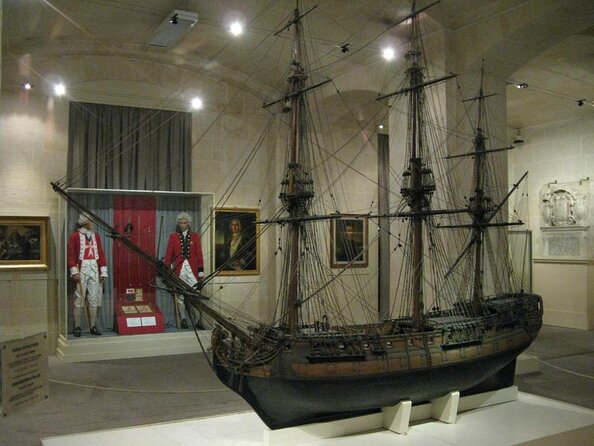
The Malta Maritime Museum occupies a former Royal Naval Bakery built in the 1840s for the Mediterranean Fleet. Its collection covers Malta’s maritime story from prehistoric times to the present, with more than 20,000 objects.
Allow about an hour at the museum, though the collection can reward a slower visit. This is one of the pass sites that adds context to the harbor cruise. From the boat, you see the shoreline and fortifications. In the museum, you learn how the sea shaped Malta’s work, defense, trade, and daily life.
The Valletta and Three Cities cruise is therefore more than a break from walking. It gives you a broad view of the Grand Harbour, while Fort St. Angelo and the Maritime Museum let you examine the same setting from land. Free Wi-Fi is included on the cruise, but the real reason to take it is the change in viewpoint.
Mdina and the world beneath the streets
The National Museum of Natural History is in Mdina’s Palazzo Vilhena, a French Baroque palace rebuilt in 1726. The museum presents Malta’s plants, animals, geology, fossils, and underwater ecosystems.
This is a good stop if you want a pause from military and religious history. Displays include minerals, insects, reptiles, birds, mammals, and fish, along with information about endemic species such as the Maltese centaury and Blue Rock Thrush. It gives the islands a natural setting before you return to the human story.
St. Paul’s Catacombs in nearby Rabat take you underground into an extensive network of galleries and tombs dating from the third to the eighth centuries CE. More than 20 hypogea in the wider St. Paul’s and St. Agatha’s complex are open to the public.
The catacombs are among the most distinctive stops on the pass. They are not polished palace rooms or open-air ruins. You walk through burial spaces cut into the ground, where Malta’s early Christian communities left evidence of their customs.
The site can feel bare in places, so do not expect a reconstructed picture of ancient daily life. Its value is the physical scale of the underground complex and the chance to see early Christian archaeology in its original setting.
The Domvs Romana, also in the Mdina area, shifts the focus to private Roman life. The house itself is incomplete, but surviving mosaics and objects show the wealth of the aristocratic family who lived there. Pairing the Domvs Romana with St. Paul’s Catacombs gives you two very different views of ancient Malta: one domestic and elite, the other funerary and communal.
Same islands, a completely different day out:
- From Malta: Full-Day Gozo UTV Tour with Lunch and Boat Ride
★ 4.6 · 4,408 reviews - The Original Valletta Walking Tour
★ 5.0 · 2,719 reviews - Valletta: 3-Hour Walking Tour
★ 4.7 · 1,605 reviews - From Malta: Full-Day Gozo Quad Tour with Lunch and Boat Ride
★ 4.8 · 1,419 reviews
Malta’s oldest temples at Ta’ Ħaġrat and Skorba
The northern temple sites are small, important, and easy to underestimate. Ta’ Ħaġrat in Mġarr includes two temples. The larger dates to about 3600 to 3200 BCE, while the smaller belongs to the period around 3300 to 3000 BCE.
These are among the world’s oldest religious sites, and they help explain why Malta’s prehistoric monuments matter so much. You will not find a large visitor complex at every temple, so read the site carefully and take time to notice the stone planning and scale.
Skorba, near Żebbiegħ, also offers megalithic remains. Excavation began relatively late, in the early 1960s, but the site provided important evidence about the earliest stages of Neolithic culture in Malta. It shares UNESCO recognition with Malta’s other megalithic temples.
Ta’ Ħaġrat and Skorba work well on a day that includes the hop-on hop-off bus. They are not the easiest sites to combine with a packed Valletta schedule, and a one-hour visit at each can involve more total time once transport is included.
The southern temple coast: Ħaġar Qim and Mnajdra
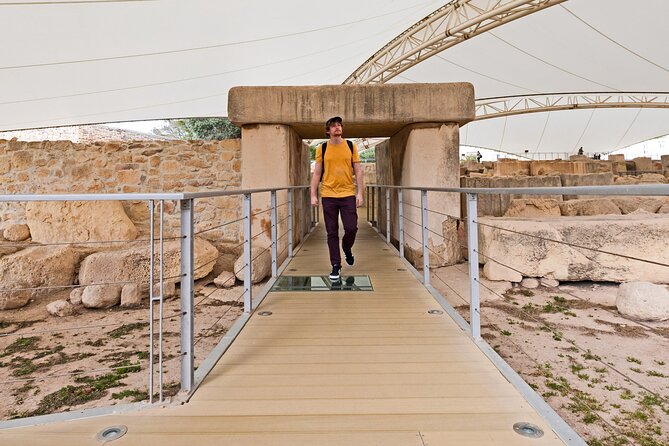
Ħaġar Qim and Mnajdra form one of the strongest pairs on the pass. The two complexes sit about 497 metres apart on Malta’s southern coast, making it possible to visit both in one outing.
Ħaġar Qim was built from Malta’s soft globigerina limestone, the rock that covers much of the islands. The exposed position and huge stones make the site feel connected to the coast around it, not separated from it by a city or modern building.
Mnajdra dates to the fourth millennium BCE and is recognized by UNESCO as a unique architectural achievement. A protective tent was completed over the site in 2009, helping shield the ancient stones from the elements.
Plan for more than the listed one hour if you want to see both complexes without rushing. The sites are close together, but the journey from Valletta or the northern resort areas can take a significant part of your day. This is exactly where the pass’s bus access can help, provided the schedule suits your plan.
The temples are a major reason to consider the pass. If you already intend to visit Ħaġar Qim and Mnajdra, then add a fort, museum, cruise, and catacombs, the combined entry and transport may begin to make financial sense.
Għar Dalam and the southern prehistoric sites
Għar Dalam is a 144-metre cave near Birżebbuġa. Its layers contain bones from animals that lived in Malta before becoming extinct at the end of the last glacial period. The site also gave its name to a period in Maltese prehistory.
The cave and museum are worthwhile for readers who like geology and early human history. The visit is more earthy and archaeological than scenic. Expect an important site rather than a grand monument.
Borġ in-Nadur lies in open fields overlooking St. George’s Bay. The site includes a Tarxien-phase megalithic temple and the remains of a Bronze Age settlement with Malta’s earliest fortification. Nearby are prehistoric cart ruts, silos, and a Roman villa at Ta’ Kaċċatura, though the pass information identifies Borġ in-Nadur itself as the attraction.
Ħal Tarxien Prehistoric Complex contains three attached temple structures, with the earliest parts dating to about 3250 BCE. The first temple is especially decorated, while the middle temple is unusual because it has three pairs of apses instead of the usual two.
Some original decorated slabs were moved to the Museum of Archaeology for protection, and the entrance was reconstructed during restoration in 1956. That is useful to know before you arrive. The site is authentic in its remains, but not every visible feature is untouched or in its original position.
How to plan three days without racing
Three days can work, but you should not treat the pass as a challenge to visit every site. The 16 named stops alone would require at least 16 hours of sightseeing before transport, meals, and delays.
For the first day, stay around Valletta and the Grand Harbour. Visit Fort St. Elmo, MUŻA, the Palace Armoury, and, if open, the State Rooms. Add the harbor cruise, then cross to Birgu for Fort St. Angelo or the Maritime Museum if time allows.
Use the second day for Mdina and Rabat. Visit the Natural History Museum, Domvs Romana, and St. Paul’s Catacombs. These sites fit together better than a random island circuit because they share the same general area.
Reserve the third day for the prehistoric sites. Choose either the southern group, Ħaġar Qim, Mnajdra, and Għar Dalam, or the northern group, Ta’ Ħaġrat and Skorba. Add Borġ in-Nadur or Ħal Tarxien only if the bus schedule and opening hours leave enough time.
The coastal route toward Comino and Gozo adds another major outing, but it may compete with the archaeological sites for your limited days. If the route is a priority, treat it as a full block of time rather than squeezing it between two distant monuments.
Bus routes can take up to several hours, depending on the route and stops. Save the stop information on your phone, and confirm where the bus picks up after you get off. Finding the next stop in Valletta and at the waterfront may not be obvious.
Is $92.69 a fair price?
The pass is expensive if you plan to visit only two or three inexpensive sites. In that case, paying as you go may be simpler and cheaper.
It becomes more appealing if you visit several of the larger sites, use the buses repeatedly, take the harbor cruise, and use the coastal route. The value comes from the combination, not just admission to individual monuments.
You should also factor in your style. If you enjoy moving quickly and visiting museums for an hour at a time, the pass can work well. If you prefer long lunches, unplanned walks, and one major sight per day, you may not use enough of it.
The published offer describes a three-day pass, but provider information also refers to six days. That is not a small detail. Check the validity printed on your ticket before planning, and use the QR code for current opening times. The pass cannot solve a closure, and several sites are not places you can visit late in the day.
Who should buy it?
I would consider this pass if you want a broad first look at Malta, plan to visit at least five or six included sites, and like having transport bundled into one ticket. It is also useful if you want to combine Valletta, Mdina, Birgu, the southern temples, and a boat trip without arranging every transfer separately.
I would skip it if your plan centers on beaches, restaurants, and a few landmark visits. I would also be cautious if you dislike fixed bus schedules or have only three partial days.
The pass is not automatically a bargain. It is a planning tool. Use it with a written route, confirmed opening times, and a short list of priority sites, and it can turn Malta’s scattered sights into a workable holiday.
FAQ
How long is the Heritage Pass valid?
The advertised experience is described as a three-day pass. Other provided information refers to a six-day validity period, so check the exact validity printed on your ticket before using it.
How much does the Heritage Pass cost?
The listed price is $92.69 per person.
Which attractions are included?
Included sites include Fort St. Elmo, MUŻA, the National Museum of Natural History, Ta’ Ħaġrat, Għar Dalam, Fort St. Angelo, the Malta Maritime Museum, Ħaġar Qim, the State Rooms, the Palace Armoury, Skorba, Borġ in-Nadur, St. Paul’s Catacombs, Domvs Romana, Ħal Tarxien, and Mnajdra.
Does the pass include public transportation?
It includes unlimited use of the hop-on hop-off bus. It also includes a coastal pass route toward Comino and Gozo.
Is a cruise included?
Yes. The pass includes a harbor cruise covering Valletta and the Three Cities. It also includes the coastal pass route toward Comino and Gozo.
Is Wi-Fi available on the cruises?
Both cruises include free Wi-Fi on board.
Can the State Rooms close?
Yes. The State Rooms may close at short notice by order of the President of Malta.
How can I check attraction opening times?
Scan the QR code connected with your pass to check the opening times of each attraction. This is especially important because site schedules and closures can affect your plan.
Can I cancel for a refund?
You can cancel at least 24 hours before the experience start time for a full refund. Cancellations or changes made within 24 hours are not accepted for a refund. If poor weather cancels the experience, you will be offered another date or a full refund.
Just added around Valletta
- Malta: 5 hr Vintage Bus Tour – Mdina & Blue Grotto inc. food★ 5.0 · 22 reviews
- World War II Malta Full-Day Walking Tour★ 4.3 · 18 reviews
- Valletta & Mdina: Private Tour★ 4.5 · 16 reviews
- Valletta: Private Maltese Cuisine Walking Tour★ 4.8 · 8 reviews
- Valletta : Highlights & Hidden Gems Walking Tour★ 3.1 · 5 reviews
- Afternoon Harbours Cruise with Guide and Roundtrip Transfers★ 3.4 · 11 reviews
- Valletta: Guided Walking Tour★ 3.8 · 5 reviews
- Valletta: Food and Culture Private Tour★ 4.9 · 10 reviews
Historical Tours, compared.
Prehistoric Temples, Limestone Heritage & Blue Grotto
Read our review →
Maltese Islands History Audio-Visual Show and La Sacra Infermeria Tour
Read our review →
Self-Guided Historical Walking Tour (Audio Guide)
Read our review →
Wonderful Valletta, gastronomy, art, and history in the Mediterranean
Read our review →



The Limestone Heritage Park and Gardens (Entry Ticket)
Read our review →Browse the lists this tour appears in