
REVIEW · HISTORICAL TOURS
The Dark History of Valletta – Walking Tour
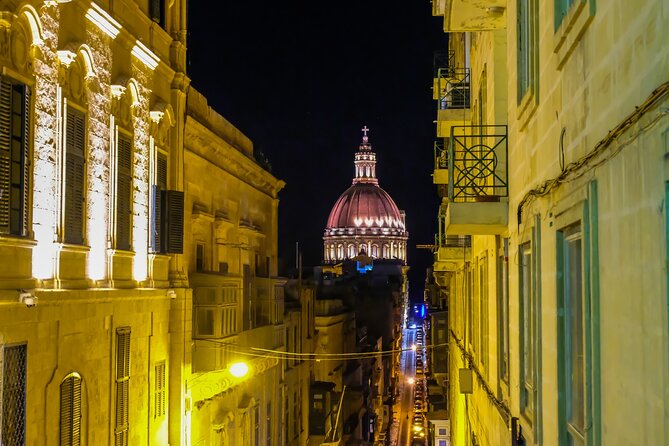
Valletta has grand churches and golden stone, but this tour takes you toward the city’s stranger side: a ghostly knight, a murder letter, a church mystery involving more than 100 boys, and a grotesque statue with a message hidden in plain sight. Dark Malta Tours turns the capital into a night-time storybook, with the past told through its streets rather than behind museum glass.
I like the sharp focus on local stories and the way the route ends near the Grand Master’s Palace, where you can sit down for a drink or meal. I also like the guides’ storytelling style. Mario, in particular, has been praised for holding a group together with cliff-hangers and for helping a late-arriving family join the tour.
The main catch is the route itself. Valletta is hilly, and this walk goes down toward the bottom of the city and back up, so you need to be mobile and reasonably fit. Comfortable shoes are essential, and poor weather can cause the tour to be moved or canceled.
In This Review
- Key points
- Why Valletta’s dark side works so well after sunset
- Starting at Tritons’ Fountain in Floriana
- Oliver Starkey and the ghost who kept partying
- The murder letter and Valletta’s darker human stories
- The church mystery involving more than 100 boys
- Jean de Valette beyond the founder’s statue
- The climb from Valletta’s lower streets
- How the guide shapes the evening
- What the $24.03 price buys you
- Who should book this evening walk
- Should you book The Dark History of Valletta?
- FAQ
- Where does The Dark History of Valletta tour begin?
- Where does the tour end?
- How long does the walking tour last?
- What language is the tour offered in?
- How much does the experience cost?
- What stories are included?
- Is the tour suitable for people with limited mobility?
- How large can the group be?
- Are service animals allowed?
- Can I cancel for a full refund?
- What happens if bad weather cancels the tour?
Key points
- Ghosts with a practical problem: Hear how the spirit of 16th-century knight Oliver Starkey held parties in the 1990s until someone convinced him to stop disturbing the neighbors.
- A murder story told through a letter: Learn about a lovesick man’s shocking message to his lover shortly before he killed her.
- A church mystery: Find out why more than 100 boys entered a church but never came out.
- A closer look at Valletta’s founder: The tour separates the real Jean de Valette from the legends surrounding him.
- An atmospheric city walk: The route begins at Tritons’ Fountain and finishes near the Grand Master’s Palace.
- A guide-led experience: The group can include up to 35 people, with English-language guiding and mobile tickets.
Why Valletta’s dark side works so well after sunset
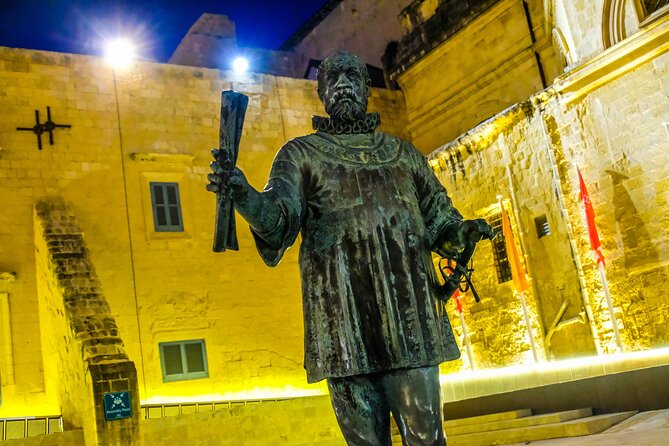
Valletta is easy to admire in daylight. Its churches, fortifications, and formal streets can also make the city feel almost too polished. A dark-history walk changes your attention. Instead of looking only at façades and monuments, you start asking what happened behind them.
That shift is the point of this tour. The stories are not presented as a general lecture about Malta. They are tied to places in the capital, so the walk gives you a reason to notice corners, statues, churches, and streets you might otherwise pass without a second thought.
The tone sounds more curious than grim. You get ghosts, crime, strange behavior, and unanswered questions, but the aim is storytelling rather than shock for its own sake. That makes the experience a good fit if you want something beyond a standard sightseeing walk but do not want a long, academic history talk.
The two-hour length is sensible. It gives the guide enough time to build a story and move between several locations without turning the evening into a major physical outing. Still, the route is active. Valletta rises and falls sharply, and the walk includes a descent to the lower part of the city before climbing back up.
A few more Malta trips to weigh up
- Malta: Prehistoric Temples, Limestone Heritage & Blue Grotto
★ 4.2 · 412 reviews - Maltese Islands History Audio-Visual Show and La Sacra Infermeria Tour
★ 4.0 · 344 reviews - Valletta: Self-Guided Historical Walking Tour (Audio Guide)
★ 3.7 · 251 reviews
Starting at Tritons’ Fountain in Floriana
The meeting point is Tritons’ Fountain on Vjal Nelson in Floriana, just outside Valletta. This matters because you should not head straight into the old city expecting to find the group there. Give yourself time to reach the fountain and check your phone before the start.
The fountain is a clear landmark, but the practical details still matter. Your confirmation is delivered at booking, and the experience uses a mobile ticket, so keep the booking accessible. The tour is offered in English.
From the start, you move toward Valletta’s streets and begin shifting from the modern arrival point into the older city. The walk is not built around admission to a series of paid attractions. The value comes from the guide’s narration and the connection between each story and the place around you.
That also means your experience depends heavily on the guide. Mario has a reputation for keeping the storytelling moving and for linking one tale to the next. A useful technique is his habit of postponing the ending of a story until the group reaches the next stop. It gives the walk a natural rhythm and keeps you looking ahead.
Oliver Starkey and the ghost who kept partying
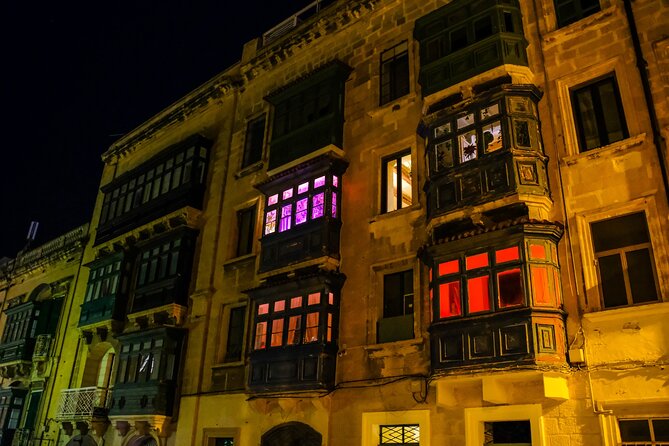
One of the tour’s most unusual stories concerns Oliver Starkey, a knight from the 16th century whose ghost supposedly began throwing parties in the 1990s. The oddest part is not just the time gap. It is the idea of a restless spirit behaving like a noisy neighbor.
The story reportedly ends in a very Valletta way: the ghost was persuaded to stop disturbing nearby residents. That detail gives the tale a touch of humor and keeps the evening from becoming a parade of murder and misery.
This is the kind of story that works best on foot. A guide can point out the setting, control the timing, and let the strange details build before explaining how the disturbance ended. You are not simply collecting a fact. You are hearing a local tale with a beginning, a problem, and a resolution.
If you enjoy ghost stories, this should be one of the stronger parts of the walk. If you prefer only firmly documented history, keep your expectations sensible. The experience is built around dark tales and local legends, not a formal academic test of every supernatural claim.
The murder letter and Valletta’s darker human stories
The tour also moves from the supernatural to a very real crime story. You hear about a lovesick man who sent a shocking letter to his lover shortly before murdering her.
That story adds weight to the tour. Ghost tales can be entertaining, but a murder connected to a written message feels more personal and disturbing. The letter gives the guide a direct way into the emotions behind the crime, while the setting connects an intimate act of violence to the public streets of Valletta.
This portion may be more unsettling than the ghost material. That is worth considering if you are traveling with young children or prefer light evening entertainment. The supplied information does not give an age limit, so use your own judgment about whether the subject suits your group.
The strongest dark-history tours balance crime with context. You want to understand why the story matters to the place, not just hear a gruesome detail. Here, the letter provides a human angle, while the walking route places the event within the city rather than separating it from its surroundings.
Same islands, a completely different day out:
- Malta: Gozo & Comino Islands, Blue Lagoon & Seacaves Tour
★ 4.5 · 15,672 reviews - Comino: Blue Lagoon, Crystal Lagoon, and Seacaves Tour
★ 4.6 · 5,673 reviews - Malta: Blue Lagoon, Beaches & Bays Trip by Catamaran
★ 4.7 · 5,496 reviews - Malta: Gozo, Comino, Blue & Crystal Lagoon, & Caves Cruise
★ 4.6 · 5,092 reviews
The church mystery involving more than 100 boys
The most puzzling story on the route asks why more than 100 boys entered a church but never came out. That is a powerful setup because it creates a question before the explanation arrives.
The story appears designed for the guide’s cliff-hanger style. You may hear the mystery introduced at one point, then walk onward before receiving the full answer. That technique was especially effective for Mario, who used one location to set up a story and another to resolve it.
This is also where the walking format earns its keep. In a conventional talk, a guide might give you the question and answer within a few minutes. On foot, the route itself stretches the suspense. You have time to look around, speculate, and notice the city while waiting for the explanation.
Do not expect an open church visit as part of the price. The experience description identifies the church story, but it does not promise entry into interiors. Think of this as an outdoor storytelling tour that uses Valletta’s buildings and streets as the setting.
Jean de Valette beyond the founder’s statue
The walk includes the truth about Jean de Valette, the man who founded the capital city. That is a useful addition because Valletta’s name and identity are closely tied to him, yet a quick visit can leave you with only a simple founder’s story.
The guide’s job here is to separate the known figure from the polished version that often appears in public history. You get a chance to consider how a capital city turns a person into a symbol, and how later generations choose which parts of his story to remember.
The tour also points out a grotesque statue above the people of Valletta and explains its hidden meanings. This detail sounds particularly rewarding for anyone who has already walked the city and failed to notice what was overhead.
Look up as you move through the streets. That is practical advice for the whole tour. Its best details may not be at eye level, and a guide’s explanation can change the way you see a familiar façade or figure.
The climb from Valletta’s lower streets
The route is not flat. You walk down toward the bottom of Valletta and then return uphill. One person described the physical demand plainly: you need to be mobile and fit enough for the descent and climb.
For most people who regularly manage city sightseeing, two hours should be manageable. The issue is not the total duration. It is the slope, the outdoor setting, and the possibility of standing while listening. If steep streets are difficult for you, ask before booking if the route can be adapted. The supplied tour details do not promise an alternative route.
Wear shoes with a good grip and avoid treating this as a dress-up-only evening. Carry water, especially in warm weather, although the tour’s schedule and exact start time are not provided here. You should also check the forecast because the experience requires good weather.
The hills can also add to the atmosphere. Moving through Valletta at night, with stories unfolding as you climb and descend, feels more connected to the city than sitting in a room listening to the same material. The physical effort is a drawback, but it is part of what makes the route feel like a real walk through the capital.
How the guide shapes the evening
A good guide matters more on a story-based tour than on a route that depends mainly on monuments. Mario’s approach is to connect each tale to the next and leave key answers hanging until the group reaches another stop.
That style keeps the pace lively. The two hours can pass quickly because you are listening, walking, and waiting for the next piece of information. One family arrived late because of heavy traffic caused by an event, and Mario called to check on them, delayed the start for them, and entertained the group with other stories while they made their way over.
You should not assume every tour will have Mario, since the available information does not guarantee a particular guide. Still, the example gives you a useful sense of the service standard to hope for: clear communication, flexibility, and storytelling that works for a mixed group.
The group can contain up to 35 people. That is large enough that you may not receive one-to-one attention, especially on a narrow street. On the other hand, a group of this size can create a good shared atmosphere for suspenseful stories. Arrive on time, stay close to the guide, and make sure you can hear before the group moves on.
What the $24.03 price buys you
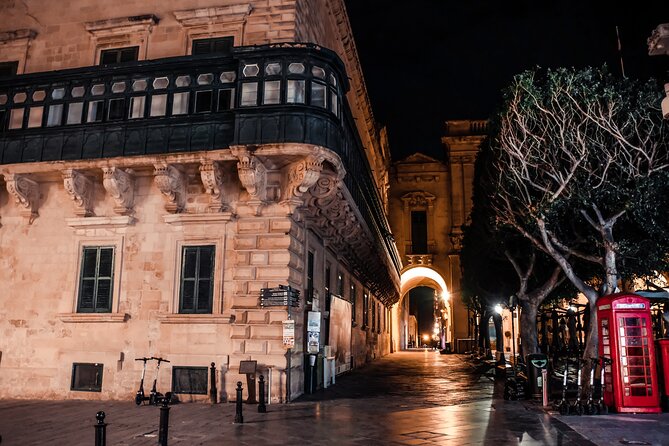
At $24.03 per person, this is not the cheapest way to spend two hours in Valletta, but it is a reasonable price if you want a prepared route and a skilled storyteller. You are paying for the guide’s research, pacing, and ability to connect separate tales into one evening rather than simply walking from one landmark to another.
There is no separate admission fee listed for the walk itself, and the experience is primarily outdoors. That keeps the cost easier to judge. If you are comfortable exploring Valletta independently, you could walk the same streets for less. You would not, however, have the guide’s explanations, timing, or local story collection.
The value is strongest for a first visit when you want an unusual introduction to the capital, or for a return visit when the standard landmarks no longer feel new. One frequent Malta visitor used the tour to learn details they had not encountered before, which is a good sign for people who already know the main sights.
Book ahead if the date matters to you. The experience is booked, on average, 19 days in advance, suggesting that it may not be a last-minute choice during busy periods.
Who should book this evening walk
I would recommend it to adults, couples, families with older children, and repeat visitors who enjoy history with a darker edge. It is especially useful if you want to see Valletta through stories rather than a checklist of famous buildings.
It suits you if you:
- Enjoy ghost stories, crime, legends, and unusual local details.
- Like a guide who builds suspense and keeps the pace moving.
- Can manage hills and two hours of outdoor walking.
- Want to finish near bars and restaurants.
- Have already seen Valletta’s main sights and want a different angle.
I would think twice if steep streets are a problem, if you need guaranteed indoor access, or if murder stories are not your idea of a pleasant evening. The tour is also weather-dependent, so keep some flexibility in your schedule.
The finish at the Grand Master’s Palace is convenient. You end in the center of Valletta, close to places for a meal or drink, so you do not need to arrange another long transfer after the walk.
Should you book The Dark History of Valletta?
Book it if you want a story-led introduction to Valletta and can handle the hills. The best reasons are the unusual material, the strong cliff-hanger format, and the chance to notice details such as the statue above the streets and the stories attached to local churches.
Skip it if you want a gentle, flat stroll or a traditional monuments tour. At $24.03, the value depends on caring about narration. If you do, this is a focused and entertaining way to spend two hours in Malta’s capital, with enough odd history to change how you look at the city afterward.
FAQ
Where does The Dark History of Valletta tour begin?
The tour begins at Tritons’ Fountain, at Vjal Nelson in Floriana, Malta.
Where does the tour end?
The tour ends at the Grand Master’s Palace in Valletta, close to bars and restaurants.
How long does the walking tour last?
The tour lasts approximately two hours.
What language is the tour offered in?
The tour is offered in English.
How much does the experience cost?
The listed price is $24.03 per person.
What stories are included?
The tour includes stories about the ghost of Oliver Starkey, a murder preceded by a shocking letter, a church mystery involving more than 100 boys, Jean de Valette, and the meaning of a grotesque statue above Valletta’s streets.
Is the tour suitable for people with limited mobility?
The route is hilly and includes walking down to the bottom of Valletta and back up, so you should be mobile and reasonably fit to participate.
How large can the group be?
The tour can have a maximum of 35 people.
Are service animals allowed?
Yes, service animals are allowed.
Can I cancel for a full refund?
Yes. You can cancel at least 24 hours before the experience starts for a full refund. Cancellations made less than 24 hours before the start time are not refunded.
What happens if bad weather cancels the tour?
If poor weather causes a cancellation, you will be offered a different date or a full refund.
Just added around Malta
- Malta: 5 hr Vintage Bus Tour – Mdina & Blue Grotto inc. food★ 5.0 · 22 reviews
- Wakeboarding Adventure in Malta: Learn to Ride★ 5.0 · 4 reviews
- World War II Malta Full-Day Walking Tour★ 4.3 · 18 reviews
- Valletta Street Food & History Tour With Private Transfers★ 4.5 · 15 reviews
- Victoria, Gozo: Sunset Walking Food and Drink Tour★ 5.0 · 6 reviews
- Valletta & Mdina: Private Tour★ 4.5 · 16 reviews
- Valletta: Private Maltese Cuisine Walking Tour★ 4.8 · 8 reviews
- Valletta: Private Massage from a world renowned masseuse★ 4.6 · 9 reviews
Historical Tours, compared.
Prehistoric Temples, Limestone Heritage & Blue Grotto
Read our review →
Maltese Islands History Audio-Visual Show and La Sacra Infermeria Tour
Read our review →
Self-Guided Historical Walking Tour (Audio Guide)
Read our review →
Wonderful Valletta, gastronomy, art, and history in the Mediterranean
Read our review →


The Limestone Heritage Park and Gardens (Entry Ticket)
Read our review →
Browse the lists this tour appears in